

ALREADY SUBSCRIBED TO
MAZDA CONNECTED
SERVICES?
Sign in to the subscription website to
view available plans and pricing or
manage your subscription.

CURIOUS ABOUT EVS?
Here are some answers to FAQs for drivers interested in making the switch.

How does the Mazda 2.5L e-Skyactiv PHEV perform in cold weather?

What is an EV battery?

What type of charger do I need at home?
How often do I need to stop and charge on longer trips?

What are the potential benefits of owning an EV?

Are electrified vehicles reliable?
How do EVs reduce tailpipe carbon emissions?
ELECTRIFIED POWERTRAINS
CHOOSE THE ELECTRIFIED MAZDA POWERTRAIN THAT FITS YOU
Our dedication to purposeful design has resulted in three powerfully performing, electrified Mazda powertrains. These e-Skyactiv systems power Mazda’s first electric SUV lineup.

MILD HYBRID (MHEV)
NO PLUG-IN REQUIRED
The Mild Hybrid powertrain combines combustion engine performance with EV technology to support a refined driving experience. Energy recovered by a compact lithium-ion battery helps reduce CO2 emissions while preserving the familiar feel of fuel-powered performance.
PLUG-IN HYBRID (PHEV)
PLUG IN WHEN YOU WANT
Plug-in hybrids bring together combustion and electrification with a larger battery, enabling longer all-electric driving when charged. With seamless switching between gasoline and battery power, drivers can enjoy confident performance on longer journeys and at higher speeds.
TYPES OF CHARGERS
Mild Hybrid EVs (MHEVs) do not need to be plugged in to charge like Plug-in Hybrid EVs (PHEVs). No matter how quickly or how often you need to charge your PHEV, there are levels of chargers that suit your driving needs at home and on the go.
COMPARE OUR ELECTRIC LINEUP
PHEV SAVING GUIDE
Discover the potential savings when you switch to a plug-in hybrid.
Explore general ownership benefits and powertrain-specific advantages for HEV, MHEV and PHEV models.
ChargePoint provides a comprehensive network of charging stations for EV owners, enabling convenient and accessible charging solutions across Canada.
The CX-70 Plug-in Hybrid, CX-90 Plug-in Hybrid and MX-30 EV are granted access to High-Occupancy Vehicle (HOV) lanes in Ontario and British Columbia. Even when carrying a single occupant, their environmental benefits allow them to travel more conveniently in these designated lanes.
A regenerative-friction brake coordination system generates the maximum amount of energy within the range of how far the driver depresses the brake pedal. Then, the M-Hybrid Boost system activates while idling and at lower speeds to reduce emissions when internal combustion engines aren't as efficient.
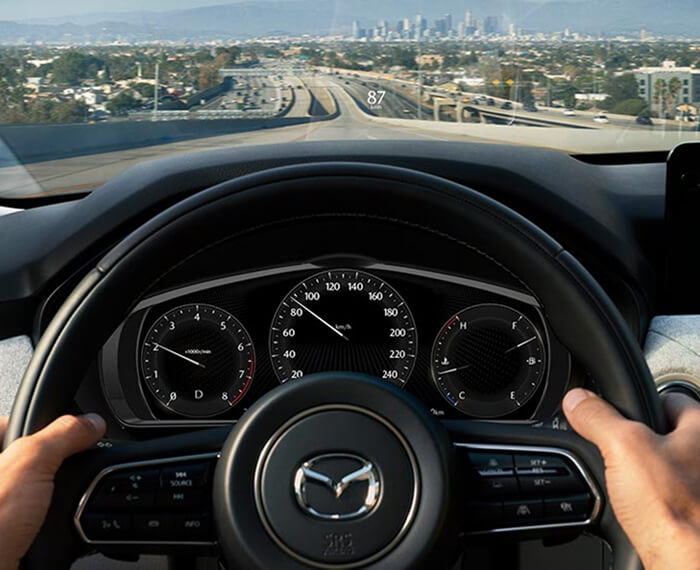
From natural posture seating and enhanced driver displays, to each performance-focused feature within reach, Mazda MHEVs deliver a sense of driving power that remains an extension of you. Seamlessly connect to the world around you to move in a way that suits your sensibilities, with you in full control.
Each part of the MHEV drivetrain was developed in unison to work in harmony with you. The result of a motor placed between the engine and transmission is a seamless transition from EV power to combustion engine performance, providing a high-quality drive from the moment you press the accelerator.
The PHEV is designed to achieve greater environmentally focused performance without compromise. By seamlessly switching between pure electric, hybrid and pure engine driving modes, the PHEV is capable of both short zero tailpipe emission trips and sprawling journeys without the worry.
Charge mode allows the driver to set the level of the PHEV's battery to a preferred State of Charge (SoC), so that when the battery might fall below that percentage, the engine will automatically activate to charge the battery. While driving above the chosen SoC, the PHEV will continue to operate in standard hybrid drive mode.
The optimally positioned PHEV battery can be charged by simply plugging it into an external power source. Regenerative braking, however, charges your battery on the go, extending your range while you drive.
COMMITTED TO CREATING BETTER GENERATIONS
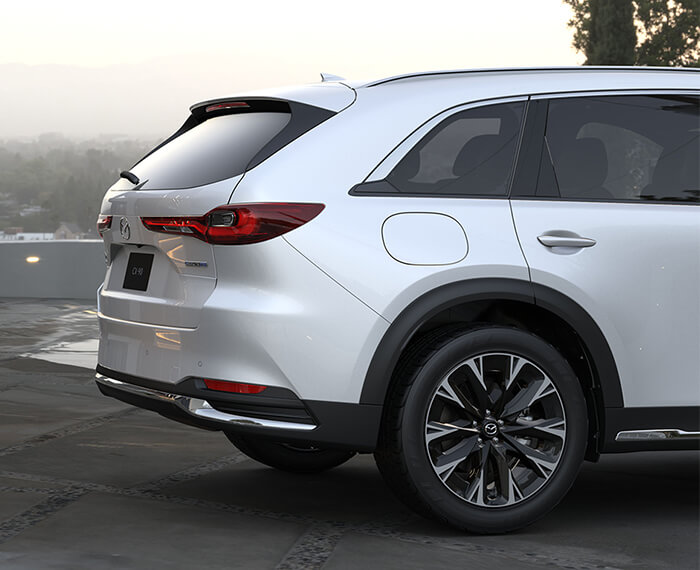
No matter how a vehicle draws power, our focus on human-centric and Kodo Design philosophies means a Mazda will always be a Mazda. Our commitment to reaching carbon neutrality across the network by 2050 remains strong as we further develop next-generation technologies for our newly electrified fleet.

LOOKING FORWARD
Mazda’s first-ever all-electric Compact SUV, the MX-30 EV, is introduced. Carefully curated with high-quality interior elements and a lightweight battery, the MX-30 is designed to perfectly balance performance and range.


We introduce North America to Mazda’s first-ever Mild Hybrid and Plug-In Hybrid EVs, the CX-90s. A lineup featuring the largest, most spacious, performance-focused SUVs also boasts Mazda’s most powerful engine to date, the Inline 6 Turbo.
Our diverse fleet of next-generation vehicles is joined by even more fully electric and hybrid options, leading the way to an all-electric future.

1The charging time is based on a battery/ambient temperature of 20° C. The actual charging time depends on the various conditions at the time of charging, such as the type of fast charging station, battery status, charging habits and the battery and ambient temperature. In cold conditions, both the battery and the ambient temperature affect the required charging time, which in certain situations can lead to a significant increase in the charging time.
2In cold weather temperature, the engine may start and use fuel, even with a fully charged battery. The use of the engine is required to ensure proper heating of the passenger cabin. Make sure there is fuel in the tank.
3Combined range estimate based on preliminary testing by Mazda. Once confirmed, the official range rating will be published in the applicable NRCan Fuel Consumption Guide. Full battery charge is required. Actual driving range will vary depending upon driving/charging habits, speed, conditions, weather, temperatures, and battery age.